
Digital Transformation Strategy: A Practical Roadmap for Organizations in Kenya
A practical guide to developing and implementing a digital transformation strategy, from digital maturity assessment and process redesign to technology, data, cybersecurity, governance, people, implementation and performance measurement.
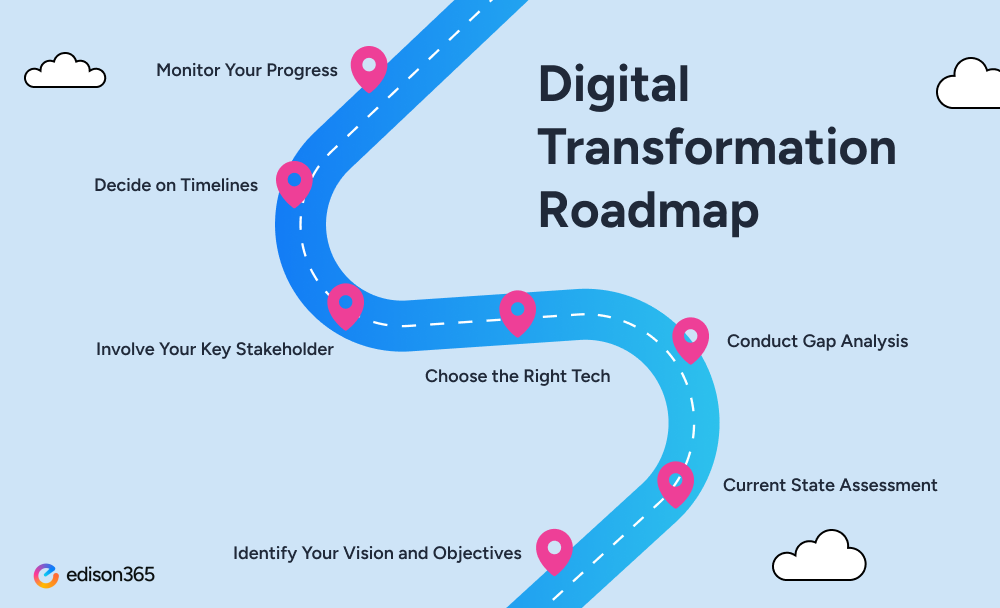
Digital transformation has become a strategic priority for organizations seeking to improve efficiency, service delivery, decision-making, resilience and stakeholder experience. Yet successful digital transformation involves considerably more than purchasing software, moving services online or adopting the latest technology.
At its core, digital transformation is an organizational change process enabled by digital technologies, data and redesigned ways of working. It requires an organization to understand where it is today, determine the capabilities it will need in the future and establish a practical roadmap for moving from the current state to the desired digital environment.
For organizations in Kenya, this transformation is taking place within a rapidly evolving environment shaped by expanding digital services, growing use of data, cloud technologies, cybersecurity risks, artificial intelligence, changing customer expectations and increasing demand for efficient and accessible services.
However, organizations differ substantially in mandate, size, resources, digital maturity and operating environment. There is therefore no single digital transformation model that can simply be copied from one institution to another.
This guide presents a practical approach to developing a digital transformation strategy that connects technology with organizational strategy, people, processes, data, governance and measurable institutional outcomes.
1. What Is Digital Transformation?
Digital transformation is the strategic use of digital technologies and data to improve how an organization operates, delivers value, makes decisions and interacts with its stakeholders.
It can involve changes to:
- business and operational processes;
- customer or citizen services;
- information systems;
- data management and analytics;
- communication and collaboration;
- organizational structures;
- workforce competencies;
- decision-making;
- cybersecurity;
- governance; and
- organizational culture.
The technology is therefore an enabler rather than the objective.
An organization that purchases sophisticated systems but retains inefficient processes, fragmented data, unclear responsibilities and low user adoption may have digitized some activities without achieving meaningful transformation.
2. Digitization, Digitalization and Digital Transformation
These three terms are related but should not be treated as identical.
Digitization
Digitization involves converting information from analogue or physical form into digital form.
Examples include scanning paper records, converting physical registers into electronic databases or replacing printed forms with electronic documents.
Digitalization
Digitalization involves using digital technologies to improve existing processes.
Examples include electronic workflow approvals, online customer applications, automated reporting or digital payment processes.
Digital Transformation
Digital transformation goes further. It considers how technology, data and redesigned processes can change the way the organization operates and delivers value.
This may involve redesigning entire service journeys, integrating previously isolated systems, automating workflows, introducing data-driven decision-making or developing new digital service-delivery models.
Understanding these distinctions helps organizations avoid equating the purchase of technology with institutional transformation.
3. Why Organizations Need a Digital Transformation Strategy
Organizations frequently undertake technology projects independently: one department acquires a system, another introduces an online platform, another builds a database and another purchases cloud services.
Without an overarching strategy, these initiatives can create:
- duplicated systems;
- fragmented data;
- integration problems;
- unnecessary costs;
- cybersecurity weaknesses;
- vendor dependency;
- poor user experience;
- inconsistent technology standards; and
- limited organizational value.
A digital transformation strategy provides a common framework connecting technology investment to institutional priorities.
It helps answer:
- What organizational problems are we trying to solve?
- Which services and processes should be transformed?
- What digital capabilities already exist?
- Where are the most important gaps?
- What technology architecture is required?
- How should organizational data be managed?
- What cybersecurity and privacy safeguards are necessary?
- What capabilities do employees need?
- Which initiatives should be prioritized?
- How much will transformation cost?
- Who will govern implementation?
- How will success be measured?
4. Start With Organizational Strategy, Not Technology
Digital transformation should begin with the organization's mandate and strategic objectives.
The central question is not:
Which technology should we buy?
It is:
What organizational outcomes are we trying to achieve, and how can digital capability help us achieve them?
For example, an organization may seek to:
- reduce service-delivery time;
- improve customer experience;
- increase operational efficiency;
- strengthen transparency;
- improve access to services;
- reduce operating costs;
- strengthen institutional resilience;
- improve regulatory compliance;
- enable evidence-based decision-making; or
- develop new products and services.
Technology priorities can then be evaluated according to their contribution to these outcomes.
This connection is particularly important when digital transformation forms part of a broader organizational strategic plan. GSC's guide on developing an effective strategic plan discusses how institutional assessment, strategic priorities, implementation and performance monitoring can be integrated into a coherent organizational strategy.
5. Step 1: Conduct a Digital Maturity Assessment
Before determining where an organization wants to go, it should understand its current digital position.
A digital maturity assessment establishes a baseline across the major dimensions of digital capability.
Depending on the organization, these may include:
- digital strategy and leadership;
- ICT governance;
- business processes;
- information systems;
- technology infrastructure;
- data management;
- analytics;
- cybersecurity;
- digital services;
- system integration;
- workforce digital skills;
- innovation capability;
- change readiness; and
- business continuity and disaster recovery.
Each dimension can be assessed using a maturity scale—for example, from initial or ad hoc capability through developing, defined, integrated and optimized capability.
The purpose is not simply to generate a maturity score. The assessment should identify specific strengths, weaknesses, dependencies and transformation priorities.
6. Step 2: Understand Stakeholder and User Needs
Digital transformation ultimately affects people.
Stakeholder engagement should therefore form part of strategy development.
Relevant stakeholders may include:
- customers or citizens;
- employees;
- management;
- governance bodies;
- regulators;
- suppliers;
- partners;
- professional associations; and
- other institutions exchanging information with the organization.
Engagement can help identify service frustrations, inefficient processes, information gaps, accessibility barriers and opportunities for digital improvement.
User needs should then inform technology and process design rather than being considered only after a system has been developed.
7. Step 3: Map and Assess Business Processes
Automating an inefficient process can simply produce an inefficient digital process more quickly.
Organizations should therefore understand existing workflows before introducing automation.
Process assessment can examine:
- process steps;
- responsible roles;
- approval levels;
- processing time;
- information requirements;
- manual handoffs;
- duplication;
- bottlenecks;
- controls;
- customer touchpoints; and
- opportunities for automation.
Processes can then be redesigned before or alongside technology implementation.
This approach helps ensure that digital transformation simplifies work rather than embedding unnecessary complexity into new systems.
8. Step 4: Assess the Existing Technology Environment
A digital strategy should document the current technology landscape.
This may include:
- enterprise applications;
- departmental systems;
- databases;
- servers;
- networks;
- cloud services;
- web platforms;
- mobile applications;
- end-user devices;
- integration mechanisms;
- software licences;
- backup infrastructure; and
- security technologies.
The assessment should identify systems that are obsolete, duplicated, unsupported, isolated or unable to meet future requirements.
It should also examine interoperability. Organizations increasingly require systems to exchange information rather than operating as independent technology islands.
9. Step 5: Assess Organizational Data
Data is one of the most important assets in digital transformation.
Yet many organizations have data distributed across spreadsheets, paper files, independent applications and departmental databases.
A data assessment should consider:
- what data the organization collects;
- where it is stored;
- who owns or manages it;
- how accurate and complete it is;
- how frequently it is updated;
- how different systems exchange data;
- how data is secured;
- how long it is retained;
- how it is used for reporting; and
- whether it supports management decision-making.
Poor data quality can significantly reduce the value of otherwise sophisticated digital systems.
10. Data Governance as a Transformation Foundation
As organizations become more data-driven, clear governance becomes increasingly important.
Data governance can establish:
- data ownership;
- data stewardship;
- quality standards;
- access controls;
- classification;
- retention requirements;
- data-sharing arrangements;
- security responsibilities;
- privacy safeguards; and
- accountability.
Without governance, different departments may maintain conflicting versions of the same information or use inconsistent definitions for key organizational indicators.
Strong data governance therefore supports both operational systems and higher-level analytics.
11. Step 6: Define the Future Digital Vision
Once the current state is understood, the organization should define the desired future state.
A digital vision should explain how the institution expects to operate after transformation.
Depending on organizational priorities, the future state might include:
- integrated enterprise systems;
- paperless workflows;
- self-service digital channels;
- mobile-accessible services;
- centralized or interoperable data;
- management dashboards;
- automated reporting;
- cloud-enabled infrastructure;
- stronger cybersecurity;
- digital collaboration;
- analytics-enabled decision-making; and
- selective use of artificial intelligence.
The vision should be ambitious enough to create meaningful change while remaining realistic about resources, institutional readiness and implementation capacity.
12. Step 7: Identify Strategic Digital Transformation Pillars
A transformation strategy can organize priorities into a manageable number of strategic pillars.
Typical pillars might include:
Digital Governance and Leadership
Establishing clear accountability, decision rights, policies and oversight arrangements.
Digital Services and Customer Experience
Improving how stakeholders access and interact with organizational services.
Business Process Transformation
Redesigning and automating workflows to improve efficiency and control.
Enterprise Systems and Integration
Strengthening core applications and interoperability between systems.
Data and Analytics
Improving data quality, governance, reporting, dashboards and analytical capability.
Cybersecurity and Digital Resilience
Protecting systems and information while strengthening recovery capability.
Digital Workforce and Culture
Developing the skills, behaviours and change readiness necessary for sustainable transformation.
The exact pillars should emerge from the assessment rather than being copied mechanically from another organization.
13. Step 8: Prioritize Digital Initiatives
Digital transformation usually generates more potential projects than an organization can implement at once.
Prioritization is therefore essential.
Initiatives can be evaluated against criteria such as:
- strategic alignment;
- expected organizational value;
- customer impact;
- operational efficiency;
- risk reduction;
- urgency;
- implementation complexity;
- cost;
- technical dependencies;
- organizational readiness; and
- availability of required skills.
A portfolio approach can distinguish quick wins from medium-term transformation initiatives and longer-term strategic investments.
14. Step 9: Develop the Digital Transformation Roadmap
The roadmap translates strategy into an implementation sequence.
For each initiative, it should identify:
- initiative or project;
- strategic objective;
- expected outcome;
- responsible owner;
- implementation period;
- dependencies;
- estimated resources;
- key risks;
- performance indicators; and
- implementation status.
Initiatives should be sequenced logically.
For example, an organization may need to improve network infrastructure and data governance before implementing advanced analytics. Core systems may need integration before a unified customer portal can provide reliable information.
A roadmap therefore represents more than a list of projects. It shows how different transformation components depend on and reinforce one another.
15. Technology Architecture and Interoperability
As the number of digital systems increases, architecture becomes strategically important.
Organizations should consider how applications, databases, infrastructure and integration mechanisms fit together.
Architecture decisions may address:
- enterprise applications;
- application programming interfaces (APIs);
- integration platforms;
- identity and access management;
- cloud architecture;
- data platforms;
- mobile services;
- network infrastructure; and
- security architecture.
Interoperability can reduce duplicate data entry, improve information consistency and enable end-to-end digital workflows.
16. Cybersecurity Must Be Designed Into Transformation
Digital transformation expands both organizational capability and digital exposure.
As more services, systems and information become connected, cybersecurity should be treated as a strategic requirement rather than a technical issue considered after deployment.
Organizations should consider:
- identity and access controls;
- authentication;
- privileged access;
- network security;
- endpoint security;
- data protection;
- vulnerability management;
- security monitoring;
- incident response;
- backup and recovery;
- staff awareness; and
- third-party risk.
The level of control should reflect organizational risk, information sensitivity and applicable requirements.
17. Digital Transformation and Business Continuity
Increasing dependence on technology means system disruption can become an organizational continuity issue.
Organizations should therefore consider resilience while designing their digital environment.
Questions include:
- Which digital systems support critical services?
- How long can those systems be unavailable?
- How much data loss can be tolerated?
- What dependencies exist on cloud, telecommunications or external providers?
- Are backups reliable and tested?
- What recovery arrangements exist?
- How will critical operations continue during technology disruption?
GSC's guide to business continuity planning explains the broader organizational framework for preparing for disruptive events.
The related Business Impact Analysis guide explains how organizations can identify critical services, dependencies and recovery priorities.
18. People Are Central to Digital Transformation
Many transformation initiatives fail to achieve their intended value because insufficient attention is given to people and organizational change.
Employees need to understand:
- why the transformation is occurring;
- how their work will change;
- what is expected of them;
- how new systems should be used;
- what support is available; and
- how the changes contribute to organizational objectives.
Resistance can arise from uncertainty, previous unsuccessful projects, inadequate communication, limited digital skills or fear that automation will eliminate roles.
Change management should therefore begin early rather than shortly before system launch.
19. Assess Digital Skills and Capacity
A transformation roadmap should be accompanied by an assessment of the capabilities required to implement and sustain it.
Depending on the organization, required competencies may include:
- digital literacy;
- ICT governance;
- project management;
- business analysis;
- data management;
- data analytics;
- cybersecurity;
- cloud administration;
- systems integration;
- change management;
- vendor management; and
- artificial intelligence literacy.
GSC's guide on conducting a capacity needs assessment explains how organizations can distinguish skills gaps from wider institutional capacity constraints and translate findings into a capacity development plan.
20. Data Analytics and Evidence-Based Management
Digital transformation creates opportunities to improve organizational decision-making.
Integrated systems can generate information about operations, customers, resources, risks and performance. However, simply accumulating data does not create insight.
Organizations need mechanisms for:
- data quality management;
- performance reporting;
- business intelligence;
- dashboard development;
- statistical analysis;
- trend analysis;
- forecasting; and
- decision support.
GSC's article on data analytics and evidence-based decision-making examines this relationship in greater detail.
21. Artificial Intelligence Within Digital Transformation
Artificial intelligence is increasingly becoming part of the digital transformation discussion. However, AI should not automatically become the starting point of an organization's digital strategy.
Successful AI applications generally depend on foundational capabilities including reliable data, appropriate infrastructure, clear use cases, governance, security and organizational readiness.
Potential applications may include:
- document analysis;
- forecasting;
- customer support;
- risk detection;
- workflow assistance;
- classification;
- predictive analytics; and
- decision support.
Organizations should evaluate these opportunities against value, risk, data availability and governance requirements.
For the Kenyan context, GSC's guide to AI opportunities, risks and responsible adoption examines these considerations more directly.
22. A Multidimensional Approach to Transformation Decisions
Digital transformation decisions rarely depend on one variable.
A proposed technology may appear attractive from a technical perspective but perform poorly when assessed against cost, workforce capability, cybersecurity, process readiness, data availability or strategic value.
Organizations therefore benefit from evaluating transformation initiatives across multiple dimensions.
This multidimensional principle is consistent with GSC's broader Multidimensional Data-Driven Approach (MDDA), which emphasizes bringing together multiple dimensions of evidence to support better-informed decisions.
MDDA should not be treated as a replacement for established ICT governance, enterprise architecture or digital-transformation methodologies. Its relevance here lies in the principle that complex transformation choices are better evaluated using multiple dimensions of evidence than through isolated technology considerations.
23. Governance of Digital Transformation
Transformation requires clear institutional ownership.
Depending on organizational size and governance structure, oversight may involve:
- the board or governing body;
- executive management;
- a digital transformation steering committee;
- ICT leadership;
- business-unit owners;
- data governance structures;
- project management functions; and
- risk and assurance functions.
Governance should define who approves priorities, allocates resources, owns outcomes, manages risks and monitors implementation.
Digital transformation should not become the responsibility of the ICT department alone. Business units must own the operational outcomes the technology is intended to improve.
24. Procurement and Vendor Management
Organizations frequently depend on external technology providers. Effective vendor management is therefore an important part of transformation.
Before acquiring solutions, organizations should establish clear functional, technical, security and service requirements.
Considerations can include:
- functional fit;
- integration capability;
- scalability;
- security;
- data ownership;
- service-level requirements;
- technical support;
- licensing;
- exit arrangements;
- knowledge transfer;
- total cost of ownership; and
- vendor dependency.
The cheapest initial acquisition is not necessarily the most economical solution over the full technology lifecycle.
25. Budgeting for Digital Transformation
Transformation budgets should consider more than software purchase costs.
Total costs may include:
- software;
- hardware;
- cloud services;
- network upgrades;
- integration;
- data migration;
- cybersecurity;
- implementation support;
- training;
- change management;
- licensing;
- maintenance;
- technical support; and
- future upgrades.
A lifecycle perspective helps management understand the long-term financial implications of digital investments.
26. Measuring Digital Transformation Performance
Transformation should be measured against organizational outcomes rather than technology installation alone.
Possible indicators include:
- percentage of priority processes digitized;
- service turnaround time;
- system availability;
- digital service adoption;
- customer satisfaction;
- cost per transaction;
- reduction in manual processing;
- data-quality improvements;
- system integration rate;
- cybersecurity incidents;
- employee digital competency;
- user adoption;
- percentage of roadmap initiatives completed; and
- realized benefits from digital investments.
Baselines should be established wherever possible so that subsequent improvements can be measured.
27. Connect Digital Transformation to Monitoring, Evaluation and Learning
A transformation roadmap should include a mechanism for monitoring implementation, evaluating results and adapting priorities as conditions change.
This involves:
- clear indicators;
- baseline values;
- targets;
- responsibilities;
- data sources;
- reporting schedules;
- management reviews; and
- learning mechanisms.
GSC's guide to Monitoring, Evaluation and Learning provides a broader framework for connecting indicators, evidence, reporting and adaptive management.
28. Common Digital Transformation Mistakes
Mistake 1: Starting With Technology
Technology should respond to an organizational problem or opportunity, not become the strategy itself.
Mistake 2: Automating Broken Processes
Process redesign should precede or accompany automation.
Mistake 3: Ignoring Data
Disconnected and poor-quality data can undermine even well-designed systems.
Mistake 4: Treating Transformation as an ICT Project
Transformation affects business processes, employees, customers and management and therefore requires organization-wide ownership.
Mistake 5: Underestimating Change Management
Systems deliver little value if employees and stakeholders do not adopt them effectively.
Mistake 6: Implementing Too Much at Once
A phased roadmap can reduce implementation risk and allow the organization to build capability progressively.
Mistake 7: Neglecting Cybersecurity and Resilience
Greater digital dependency creates new operational and information risks.
Mistake 8: Failing to Measure Benefits
Completing a technology project does not necessarily mean that the intended organizational value has been realized.
29. A Practical Digital Transformation Roadmap
Organizations can structure transformation around the following sequence:
- Establish strategic objectives. Define the organizational outcomes transformation should support.
- Assess digital maturity. Determine the current state of technology, data, processes, people and governance.
- Engage stakeholders. Understand user needs, operational challenges and service expectations.
- Map critical processes. Identify inefficiencies, bottlenecks and opportunities for redesign.
- Assess systems and infrastructure. Document existing technology and integration requirements.
- Assess data capability. Examine quality, governance, availability and analytical use.
- Assess cybersecurity and resilience. Identify technology risks and continuity requirements.
- Define the future digital state. Establish the organization's desired digital operating environment.
- Identify strategic pillars. Organize transformation priorities into coherent themes.
- Develop initiatives. Translate priorities into specific transformation programmes and projects.
- Prioritize. Evaluate initiatives according to value, urgency, risk, cost and feasibility.
- Build the roadmap. Sequence initiatives according to dependencies and organizational readiness.
- Establish governance. Assign accountability and decision-making arrangements.
- Develop capacity. Strengthen workforce competencies and change readiness.
- Implement progressively. Deliver transformation through manageable phases.
- Monitor performance. Track implementation and realized organizational benefits.
- Review and adapt. Update the roadmap as technology and organizational requirements evolve.
30. From Digital Projects to Organizational Transformation
The difference between technology implementation and digital transformation lies in organizational value.
A new system may digitize an activity. An integrated transformation programme can change how information flows, how employees work, how customers access services and how management makes decisions.
Organizations should therefore evaluate digital investments through multiple questions:
- Does this initiative support our strategy?
- Does it solve a meaningful organizational problem?
- Does it improve stakeholder experience?
- Does it simplify or improve a process?
- Can it integrate with our existing environment?
- Do we have the necessary data?
- Can we secure and sustain it?
- Do our people have the required capabilities?
- Can we afford its lifecycle cost?
- How will we measure its value?
These questions shift digital transformation from technology acquisition toward evidence-based institutional change.
Conclusion
A successful digital transformation strategy connects organizational priorities with processes, technology, data, cybersecurity, people, governance and measurable outcomes.
The process should begin by understanding the organization's current digital maturity and strategic objectives. It should then identify stakeholder needs, redesign processes, assess technology and data, define the desired future state, prioritize initiatives and establish a realistic implementation roadmap.
Equally important, transformation requires effective governance, appropriate investment, workforce capability, change management, cybersecurity and continuous performance monitoring.
Organizations should therefore avoid treating digital transformation as a one-time technology project. It is an ongoing institutional process through which digital capability evolves alongside organizational strategy, stakeholder expectations and technological change.
Global Signature Consultancy supports organizations in digital transformation strategy, ICT strategy, digital maturity assessment, process improvement, information systems planning, data and analytics, institutional capacity development and implementation roadmap development. These capabilities can be integrated with strategic planning, research, artificial intelligence, business continuity and monitoring, evaluation and learning to support sustainable organizational transformation.
Related Projects
Related Expertise
Explore GSC services connected to this Insight and complementary expertise that can support wider institutional outcomes.

Digital Transformation & ICT Consulting
Helping organizations assess digital maturity, develop ICT and digital transformation strategies, strengthen technology governance, redesign processes and build practical roadmaps for sustainable digital transformation.
Explore Service →
Software Development & Information Systems
Custom software and information systems can implement digital transformation requirements through operational applications, databases, workflows, integrations and other technology solutions.
Explore Service →
Data Analytics & Artificial Intelligence
Data analytics and artificial intelligence can strengthen digital transformation through business intelligence, predictive analytics, decision support and responsible adoption of data-driven technologies.
Explore Service →
Policy Development & Institutional Frameworks
Institutional policies, procedures and governance frameworks can support the organizational controls and accountability arrangements required for sustainable digital transformation.
Explore Service →
Business Continuity Planning
Business continuity planning helps ensure that critical digitally enabled services, technology dependencies and recovery requirements are considered as organizations transform their operations.
Explore Service →
Capacity Building and Training
Capacity building helps leadership, ICT teams and users develop the knowledge, skills and digital capabilities required to adopt new technologies and sustain organizational transformation.
Explore Service →