
Monitoring, Evaluation and Learning: Building an Effective MEL Framework
A practical guide to building an effective Monitoring, Evaluation and Learning framework that connects organizational objectives, results, indicators, data, evaluation and learning to stronger evidence-based decision-making.

Organizations increasingly operate in environments where funders, boards, management teams, regulators, communities and other stakeholders expect evidence that programmes, strategies and investments are producing meaningful results.
Collecting data alone, however, does not create accountability or improve performance.
An effective Monitoring, Evaluation and Learning (MEL) system connects organizational objectives with measurable results, reliable evidence, systematic evaluation and continuous learning. It enables an organization to understand what is happening, determine whether expected results are being achieved, explain why performance differs from expectations and use that evidence to improve implementation and future decisions.
The most useful MEL systems therefore move beyond reporting.
They create a continuous evidence cycle:
STRATEGY → THEORY OF CHANGE → RESULTS → INDICATORS → DATA → ANALYSIS → REPORTING → EVALUATION → LEARNING → ADAPTATION → IMPROVED RESULTS
This article provides a practical guide to designing and implementing an organizational MEL framework, from Theory of Change and results chains to indicators, baselines, data quality, evaluation, dashboards, learning and adaptive management.
What Is Monitoring, Evaluation and Learning?
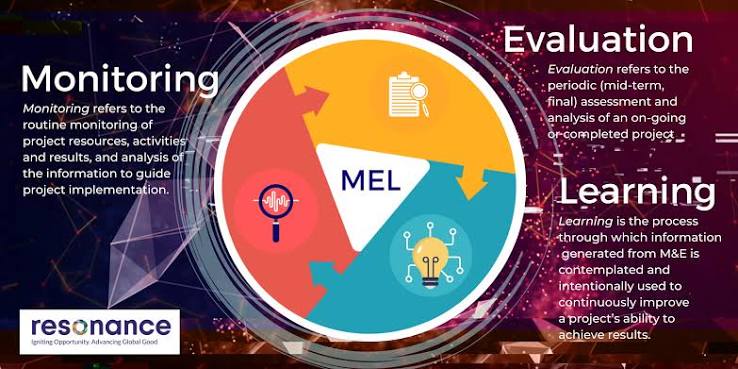
Monitoring, Evaluation and Learning brings together three related but distinct organizational functions.
Monitoring
Monitoring is the systematic and continuous collection, analysis and use of information about implementation and performance.
Monitoring helps organizations answer questions such as:
- Are planned activities being implemented?
- Are outputs being delivered?
- Are resources being used as expected?
- Are performance indicators moving toward their targets?
- Which areas are progressing well?
- Where are implementation delays or performance gaps emerging?
Monitoring is therefore primarily concerned with understanding progress during implementation.
Evaluation
Evaluation involves a more systematic assessment of an intervention, programme, project, strategy or policy.
Evaluation may examine questions such as:
- Was the intervention relevant to the identified problem?
- Were activities implemented effectively?
- Were resources used efficiently?
- Were intended outcomes achieved?
- What factors contributed to or constrained results?
- Were there unintended results?
- Are the achieved results likely to be sustained?
Evaluation therefore goes beyond asking what happened. It seeks to understand the significance of results and, where the evaluation design and evidence permit, why those results occurred.
Learning
Learning is the structured use of monitoring, evaluation, research, stakeholder experience and other evidence to improve organizational understanding and action.
Learning asks:
- What does the evidence tell us?
- What assumptions have been confirmed or challenged?
- What should we continue doing?
- What should we change?
- What should we stop doing?
- What new questions should we investigate?
Learning is what turns MEL from a reporting function into a management capability.
M&E and MEL: What Is the Difference?
Monitoring and Evaluation, commonly referred to as M&E, traditionally focuses on tracking implementation, measuring results and assessing performance.
MEL retains those functions but places stronger emphasis on organizational learning and the use of evidence to adapt implementation and improve decisions.
The distinction can be summarized as:
M&E: Are we implementing what we planned, and are we achieving results?
MEL: What are we achieving, what are we learning, why does it matter, and how should that evidence change what we do next?
This does not mean every organization needs a completely separate learning department. Rather, learning should be deliberately built into monitoring, evaluation, reporting, management review and decision-making processes.
Why Organizations Need a MEL Framework
A MEL framework provides the structure through which an organization defines expected results, determines how those results will be measured, assigns responsibility for collecting evidence and establishes how findings will be analysed, reported and used.
Without such a framework, organizations may collect large quantities of data without knowing which information actually matters.
An effective MEL framework can support:
- performance monitoring;
- management accountability;
- programme and project oversight;
- strategic-plan implementation;
- evidence-based decision-making;
- resource allocation;
- stakeholder and donor reporting;
- risk identification;
- organizational learning;
- programme improvement; and
- future planning.
The framework should therefore be designed around decisions and results, not merely around reporting requirements.
Explore GSC Monitoring, Evaluation & Learning Services →
Start with Strategy, Not Indicators
One of the most common MEL design mistakes is starting with indicators.
Organizations sometimes begin by asking:
“What indicators should we measure?”
A stronger question is:
“What change are we trying to achieve, how do we expect that change to happen, and what evidence would demonstrate progress?”
Indicators should emerge from the organization's objectives and expected results.
A useful sequence is:
PROBLEM → OBJECTIVES → THEORY OF CHANGE → RESULTS → INDICATORS → DATA SOURCES → ANALYSIS → LEARNING
For an organizational strategic plan, this means the MEL framework should be directly connected to strategic priorities, objectives and initiatives.
Explore GSC Strategic Planning Services →
Developing a Theory of Change
A Theory of Change explains how and why an intervention is expected to contribute to desired change.
It connects the problem being addressed with activities, expected results, assumptions and the broader conditions that may influence success.
A Theory of Change should help an organization explain:
- what problem it is addressing;
- who is affected;
- what changes are expected;
- how organizational activities are expected to contribute to those changes;
- which assumptions must hold;
- which external factors may influence results; and
- what evidence will be needed to test the change pathway.
The Theory of Change should not be treated merely as a diagram prepared at the beginning of a programme and then forgotten.
It should remain a working hypothesis about how change is expected to occur.
Monitoring and evaluation evidence can then be used to test whether the assumptions and relationships represented in that theory remain credible.
Building the Results Chain
The Theory of Change can be translated into a more operational results chain.
A typical results chain may include:
INPUTS → ACTIVITIES → OUTPUTS → OUTCOMES → IMPACT
Inputs
Inputs are the resources used to implement an intervention, such as funding, personnel, equipment, information, infrastructure and technical expertise.
Activities
Activities are the actions undertaken using those resources.
Examples include training, research, service delivery, infrastructure development, stakeholder engagement or system implementation.
Outputs
Outputs are the immediate products or services generated by activities.
Examples might include people trained, reports produced, systems installed, policies developed or services delivered.
Outcomes
Outcomes describe changes expected to occur as outputs are used.
These may involve changes in behaviour, organizational capacity, service quality, institutional performance, access, efficiency or other conditions.
Impact
Impact refers to broader and often longer-term changes to which the intervention may contribute.
A strong MEL system distinguishes these levels because counting activities or outputs is not the same as demonstrating outcomes.
For example, reporting that 500 people attended training demonstrates participation. It does not, by itself, demonstrate that knowledge increased, behaviour changed or organizational performance improved.
Developing Meaningful Indicators
Indicators translate expected results into observable measures.
An indicator should help determine whether progress is occurring and whether a result has been achieved.
Indicators may be quantitative or qualitative.
Quantitative Indicators
These express results numerically.
Examples include:
- percentage of customers receiving services within the required time;
- number of staff completing competency-based training;
- percentage increase in revenue;
- average processing time;
- percentage of programme beneficiaries achieving a defined outcome; or
- system availability during a reporting period.
Qualitative Indicators
Qualitative indicators can capture perceptions, experiences, institutional changes or other dimensions that are difficult to understand through numerical measures alone.
Evidence may be generated through interviews, focus groups, observations, case studies, structured assessments or other qualitative methods.
Characteristics of Useful Indicators
Indicators should generally be:
- clearly defined;
- relevant to the intended result;
- measurable using available or obtainable evidence;
- consistent enough to support comparison over time;
- practical to collect;
- sensitive enough to detect meaningful change; and
- understandable to those responsible for using them.
Organizations should avoid selecting indicators merely because the data is easy to collect.
The indicator should measure something that matters.
Indicator Reference Sheets
Where an organization has numerous indicators or multiple people responsible for reporting, an Indicator Reference Sheet can improve consistency.
For each indicator, the organization can document:
- indicator name;
- definition;
- purpose;
- unit of measurement;
- calculation method;
- disaggregation requirements;
- data source;
- collection method;
- collection frequency;
- reporting frequency;
- responsible person or department;
- baseline;
- target; and
- known limitations.
This reduces the risk that different departments interpret the same indicator differently.
Establishing Baselines and Targets
Indicators become more useful when organizations know where performance begins and what level of performance they intend to achieve.
Baseline
A baseline establishes the starting condition against which future performance can be compared.
Depending on the indicator, baseline information may come from:
- existing administrative records;
- historical performance data;
- baseline surveys;
- system records;
- financial records;
- operational assessments; or
- other credible sources.
Target
A target specifies the expected level of performance within a defined period.
Targets should be ambitious enough to encourage improvement but sufficiently realistic to remain useful for management.
Targets should be informed where possible by baseline performance, organizational capacity, available resources, historical trends, strategic ambition and the operating environment.
Arbitrary targets can weaken accountability because they provide little meaningful basis for judging performance.
Identifying Data Sources and Means of Verification
Every indicator should have a credible source of evidence.
Possible data sources include:
- management information systems;
- financial systems;
- customer databases;
- programme records;
- attendance registers;
- service-delivery records;
- surveys;
- interviews;
- focus-group discussions;
- observations;
- administrative datasets;
- digital platforms;
- external datasets; and
- research studies.
The source should be appropriate to the indicator and sufficiently reliable for the decisions that will depend on it.
Organizations should also distinguish between a data source and a means of verification. The source describes where information originates, while the means of verification identifies the evidence that can be used to confirm the reported result.
Designing Data-Collection Methods and Responsibilities
A MEL framework should clearly establish how information will be collected.
For each indicator or evaluation question, the organization should determine:
- what information is required;
- where it will come from;
- who will collect it;
- how it will be collected;
- how frequently it will be collected;
- how it will be stored;
- who will validate it;
- who will analyse it; and
- how and when it will be reported.
These responsibilities should be embedded in organizational processes rather than being left entirely to the MEL function.
Departments responsible for implementation should understand their responsibility for producing reliable performance evidence.
Building Data Quality into the MEL System
A sophisticated dashboard cannot compensate for unreliable underlying data.
Data quality should therefore be designed into the MEL system from the beginning.
Important dimensions may include:
- Accuracy: does the information correctly represent what occurred?
- Completeness: are required records and fields available?
- Consistency: are definitions and methods applied consistently?
- Timeliness: is information available when decisions need to be made?
- Validity: does the measure represent what it is intended to measure?
- Integrity: is information protected from inappropriate alteration?
Organizations can strengthen data quality through standardized definitions, validation rules, documented procedures, staff training, periodic verification and data-quality assessments.
Where important decisions depend on a dataset, the organization should understand its limitations rather than treating all recorded information as equally reliable.
Turning Monitoring Data into Management Information
Collecting indicators is only the beginning.
The next step is to transform monitoring data into information that managers and programme teams can use.
Useful performance analysis may examine:
- actual performance against targets;
- performance over time;
- differences between locations, departments or population groups;
- implementation delays;
- resource utilization;
- relationships between activities and results;
- emerging risks;
- unexpected outcomes; and
- areas requiring management attention.
This is where MEL begins to connect directly with evidence-based management.
A performance report should therefore explain not only what the numbers are, but also what they mean and what action may be required.
Dashboards, Data Analytics and Performance Visualization
Digital dashboards can make performance information easier to interpret by bringing important indicators, trends and exceptions together in one place.
Dashboards may display:
- key performance indicators;
- target achievement;
- performance trends;
- geographical differences;
- programme coverage;
- budget and expenditure information;
- implementation status;
- risk indicators; and
- areas requiring management attention.
However, a dashboard should not become a decorative reporting product.
Its value depends on whether the underlying indicators are meaningful, the data is reliable and managers actually use the information.
Data analytics can extend MEL beyond descriptive reporting by helping organizations identify patterns, relationships, anomalies and trends within performance information.
Explore How Data Analytics Can Improve Evidence-Based Decision-Making →
The principle remains the same: analytical sophistication should serve the decision requirement rather than becoming an objective in itself.
Evaluation: Asking Whether the Intervention Is Working and Why
Monitoring can show whether performance is changing, but organizations sometimes need deeper investigation to understand why.
Evaluation can examine the design, implementation, results and broader significance of an intervention.
Different evaluations may be undertaken at different stages.
Formative Evaluation
Formative evaluation can support programme design or early implementation by identifying opportunities for improvement.
Process Evaluation
Process evaluation examines how an intervention is being implemented and whether implementation corresponds with the intended design.
Outcome Evaluation
Outcome evaluation examines whether expected changes have occurred.
Impact Evaluation
Where appropriate designs and evidence are available, impact evaluation seeks to determine the extent to which observed changes can be attributed to an intervention rather than other factors.
Economic or Efficiency Evaluation
Organizations may also examine the relationship between resources used and results achieved.
The appropriate evaluation approach depends on the questions being asked, available evidence, resources, timing and the level of causal inference required.
Evaluation Questions Should Drive Evaluation Design
Organizations should avoid selecting evaluation methods before defining what they need to know.
A stronger sequence is:
DECISION NEED → EVALUATION QUESTION → EVIDENCE REQUIRED → METHOD → ANALYSIS → FINDINGS → USE
For example, an organization asking whether implementation occurred as planned requires different evidence from an organization asking whether an intervention caused a measurable outcome.
The evaluation design should therefore follow the question.
Combining Quantitative and Qualitative Evidence
Many organizational questions cannot be understood adequately through a single type of evidence.
Quantitative information may show the scale, frequency or distribution of a result, while qualitative information can help explain experiences, mechanisms and contextual factors behind that result.
For example, monitoring data might show that service uptake declined in a particular location.
Interviews, focus groups or stakeholder engagement may then help explain why.
Combining evidence can therefore provide a richer understanding than relying on one source alone.
Explore GSC Research & Surveys Services →
From Reporting to Learning
Organizations often invest considerable effort in producing monthly, quarterly and annual reports.
Yet reports create limited value if they are submitted, archived and rarely discussed.
A learning-oriented MEL system asks what should happen after the report is produced.
Useful learning mechanisms can include:
- periodic performance-review meetings;
- after-action reviews;
- programme reflection sessions;
- management review meetings;
- learning workshops;
- evaluation dissemination sessions;
- communities of practice;
- lessons-learned repositories; and
- structured follow-up on agreed actions.
The purpose is to convert evidence into organizational knowledge and organizational knowledge into better action.
Learning Loops and Adaptive Management
A learning loop occurs when evidence from implementation is fed back into management and programme decisions.
A simple learning loop can be expressed as:
IMPLEMENT → MONITOR → ANALYSE → REFLECT → DECIDE → ADAPT → IMPLEMENT AGAIN
This is particularly important where organizations operate in changing or uncertain environments.
Adaptive management does not mean changing direction without discipline.
It means making deliberate adjustments when credible evidence indicates that assumptions, activities, resource allocations or implementation approaches need to change.
The organization should document important adaptations and the evidence that informed them. This creates an institutional record of learning rather than relying entirely on individual memory.
Integrating Stakeholder Feedback
Performance information generated internally does not always capture how stakeholders experience an intervention.
A robust MEL framework can therefore incorporate feedback from relevant groups such as:
- customers;
- programme participants;
- employees;
- partners;
- communities;
- suppliers;
- management;
- funders; and
- other affected stakeholders.
Feedback mechanisms may include surveys, interviews, complaints and feedback systems, focus groups, stakeholder forums, digital channels and participatory review processes.
The important issue is not simply collecting feedback. Organizations should establish how significant feedback is analysed, escalated and incorporated into decisions.
MEL Governance, Roles and Responsibilities
MEL is sometimes treated as the responsibility of a single officer or department.
In practice, effective MEL requires shared organizational responsibility.
Roles may include:
- Board or governing body: oversight of strategic performance and accountability;
- Senior management: use of evidence for organizational decisions and corrective action;
- Programme or departmental managers: responsibility for implementation and performance;
- MEL function: framework design, technical standards, coordination, analysis and learning support;
- Data owners: responsibility for source-system accuracy and completeness;
- ICT or information systems teams: support for data infrastructure and systems;
- Finance: connection between resources, expenditure and performance where relevant; and
- Staff and implementing partners: timely and accurate recording of implementation information.
Clear accountability reduces the risk that MEL becomes detached from operational management.
Using Multidimensional Evidence for Complex Decisions
Some organizational decisions cannot be understood adequately through a single indicator or dataset.
Performance may be influenced simultaneously by financial conditions, operational capacity, stakeholder behaviour, geographical differences, organizational processes, demographic characteristics, external events and other contextual factors.
In such situations, organizations may need to integrate multiple dimensions of evidence.
This may involve combining:
- performance indicators;
- survey findings;
- financial information;
- operational data;
- qualitative evidence;
- stakeholder feedback;
- geographical information;
- external contextual data; and
- historical trends.
The objective is not to create complexity unnecessarily. It is to avoid making important decisions from an incomplete view of the evidence.
Where MDDA Can Strengthen MEL and Decision Intelligence
The Multidimensional Data-Driven Approach (MDDA) provides a research-driven framework for situations where decision-makers need to integrate multiple dimensions of information and move from evidence toward structured decision support.
Its broader decision process can be expressed as:
DEFINE → INTEGRATE → ANALYZE → OPTIMIZE → VALIDATE → ACT & MONITOR
Within a MEL environment, relevant MDDA principles can help organizations think more systematically about:
- defining the decision problem;
- integrating multiple sources and dimensions of evidence;
- analysing patterns and relationships;
- evaluating alternative actions where appropriate;
- validating analytical findings;
- combining evidence with stakeholder and professional judgment; and
- monitoring results after decisions are implemented.
MDDA should not replace a conventional MEL framework where the latter adequately addresses the organization's needs.
Rather, it can provide an additional decision-intelligence perspective where evidence is multidimensional, analytical questions are complex or decision-makers need to integrate several forms of information.
Explore the MDDA Decision-Intelligence Framework →
Common MEL Framework Mistakes
Even well-intentioned MEL systems can become ineffective when design and implementation focus more on compliance than usefulness.
1. Measuring Too Many Indicators
Large indicator lists can overwhelm staff and produce substantial reporting effort without generating proportionate decision value.
Organizations should prioritize indicators that genuinely help assess important results.
2. Focusing Only on Activities and Outputs
Counting meetings, trainings, reports or participants may be useful, but these measures do not necessarily demonstrate meaningful outcomes.
3. Setting Targets Without Evidence
Targets that are disconnected from baselines, capacity and operating conditions provide a weak basis for performance assessment.
4. Collecting Data That Nobody Uses
If an indicator is repeatedly reported but never informs accountability, learning or decisions, the organization should reconsider why it is being collected.
5. Ignoring Data Quality
Reporting inaccurate information quickly is not better than reporting reliable information appropriately.
6. Treating Evaluation as an End-of-Project Exercise
Evaluation can support learning throughout the intervention lifecycle, not only at closure.
7. Producing Reports Without Learning
Reporting should lead to discussion, decisions and follow-up actions.
8. Separating MEL from Management
MEL becomes less useful when it operates as a parallel technical function rather than being connected to planning, budgeting, implementation and management review.
9. Assuming Technology Will Fix Weak MEL Design
Digital platforms and dashboards can improve efficiency, but they cannot compensate for poorly defined results, inappropriate indicators or unreliable data.
A Practical Organizational MEL Framework
A comprehensive organizational MEL framework can bring together the following components:
1. Strategic and Programme Objectives
Define what the organization or intervention is seeking to achieve.
2. Theory of Change
Explain how activities are expected to contribute to desired results and identify important assumptions.
3. Results Framework
Translate the Theory of Change into clearly defined outputs, outcomes and longer-term results.
4. Indicators
Establish meaningful measures for priority results.
5. Baselines and Targets
Determine starting conditions and expected performance levels.
6. Data Sources and Collection Methods
Define where evidence will come from and how it will be collected.
7. Data Quality Arrangements
Establish standards, validation procedures and accountability for data quality.
8. Analysis
Determine how evidence will be examined to identify performance, trends, differences, risks and emerging issues.
9. Reporting and Visualization
Define how information will reach managers, boards, programme teams, funders and other stakeholders.
10. Evaluation
Identify priority evaluation questions, timing and appropriate evaluation approaches.
11. Learning
Establish mechanisms through which evidence will be discussed, interpreted and converted into organizational knowledge.
12. Adaptive Management
Define how evidence-based recommendations and learning will influence implementation and future planning.
13. Governance and Responsibilities
Clarify who owns, produces, validates, analyses, reports and uses performance information.
The framework can therefore be summarized as:
OBJECTIVES → CHANGE LOGIC → RESULTS → MEASUREMENT → EVIDENCE → ANALYSIS → ACCOUNTABILITY → LEARNING → ADAPTATION
A Step-by-Step MEL Implementation Roadmap
Organizations establishing or strengthening MEL can use a phased approach.
Stage 1: Define the Purpose of the MEL System
Determine what decisions, accountability requirements and learning needs the system should support.
Stage 2: Review Strategy and Programme Logic
Examine strategic objectives, programme design, existing results frameworks and assumptions.
Stage 3: Develop or Refine the Theory of Change
Clarify how the organization's activities are expected to contribute to desired outcomes.
Stage 4: Develop the Results Framework
Define outputs, outcomes and longer-term results clearly.
Stage 5: Select Indicators
Choose a manageable set of meaningful indicators linked directly to priority results.
Stage 6: Establish Baselines and Targets
Determine current performance and define expected future performance.
Stage 7: Map Data Sources
Identify existing data and determine where new collection mechanisms are necessary.
Stage 8: Establish Data-Collection and Quality Procedures
Define methods, frequencies, responsibilities, validation requirements and storage arrangements.
Stage 9: Develop Reporting and Dashboard Arrangements
Determine what different users need to see, how frequently they need it and the most useful format.
Stage 10: Establish Evaluation Priorities
Identify the important questions that routine monitoring cannot adequately answer.
Stage 11: Create Learning Mechanisms
Establish performance reviews, reflection processes and other mechanisms through which evidence will be interpreted and acted upon.
Stage 12: Assign Governance and Accountability
Define responsibility for data, reporting, review, decisions and follow-up actions.
Stage 13: Build Staff Capability
Ensure that relevant staff understand indicators, data-quality requirements, analysis, reporting and evidence use.
Stage 14: Implement, Review and Improve
Monitor the MEL system itself and refine it as organizational needs, strategies and operating conditions change.
How to Assess Whether a MEL System Is Working
A MEL system should itself be evaluated.
Useful questions include:
- Are indicators clearly linked to organizational objectives?
- Is required data available when needed?
- Is the data sufficiently accurate and complete?
- Are reports produced on time?
- Do reports explain performance rather than simply present figures?
- Are managers using evidence in decisions?
- Are evaluation findings acted upon?
- Are lessons documented and shared?
- Are agreed corrective actions followed through?
- Is unnecessary reporting being eliminated?
- Can the organization demonstrate how evidence has influenced implementation?
A technically sophisticated MEL framework that is not used by decision-makers is not an effective MEL system.
Building a Culture of Evidence and Learning
The strongest MEL systems depend on organizational culture as much as technical design.
Staff should be able to discuss underperformance, uncertainty and unexpected findings without treating every negative result as a reporting failure.
If performance information is used primarily to assign blame, people may become defensive and reporting quality may deteriorate.
An evidence-oriented organization instead asks:
- What happened?
- Why did it happen?
- What evidence supports that interpretation?
- What have we learned?
- What should change?
- Who is responsible for the change?
- How will we know whether the change worked?
This does not remove accountability.
It strengthens accountability by connecting performance information with explanation, action and follow-up.
From MEL to Evidence-Based Organizational Management
The long-term value of MEL lies in its integration with the wider management system.
Strategic planning defines where the organization intends to go.
Implementation translates strategy into activities and initiatives.
MEL provides evidence about whether implementation and results are progressing as expected.
Research and evaluation help explain important questions.
Data analytics helps identify patterns and extract additional insight.
Management uses that evidence to decide what should continue, change or receive greater attention.
The cycle then begins again.
PLAN → IMPLEMENT → MONITOR → EVALUATE → LEARN → ADAPT → IMPROVE
This is how MEL moves from a reporting obligation to an institutional capability for continuous improvement.
Continue Exploring Evidence-Based Decision-Making
Monitoring, evaluation and learning becomes even more valuable when performance evidence is connected with broader analytical and decision-support capabilities.
How Data Analytics Can Improve Evidence-Based Decision-Making in Organizations →
Explore how organizations can move from collecting information to analysing patterns, generating insights and supporting stronger management decisions.
Explore the research-driven MDDA framework for integrating multidimensional evidence, analysis, validation and structured decision support.
Applying MDDA to Strategic Planning: The FOCUS CFS Strategic Plan 2027–2031 →
See how relevant MDDA principles were adapted to a practical strategic-planning process involving integrated evidence, multidimensional analysis, scenario analysis and stakeholder validation.
Conclusion
An effective Monitoring, Evaluation and Learning framework does much more than collect indicators and produce reports.
It creates a structured connection between organizational objectives, expected results, evidence, accountability, evaluation, learning and management action.
The strongest MEL systems begin with a clear understanding of the change an organization is trying to achieve. They establish meaningful results and indicators, reliable baselines and targets, appropriate data sources, clear responsibilities and strong data-quality processes.
They then go further.
They transform monitoring data into management information, use evaluation to investigate important questions, integrate quantitative and qualitative evidence, create structured learning mechanisms and ensure that findings influence implementation and future decisions.
Technology, dashboards, advanced analytics and multidimensional approaches such as MDDA can strengthen this process where appropriate, but they should support rather than replace the fundamentals of sound MEL design.
The central question is therefore not simply:
“What should we measure?”
It is:
“What are we trying to achieve, what evidence will tell us whether we are progressing, what are we learning from that evidence, and how will that learning improve what we do next?”
When organizations can answer those questions systematically, MEL becomes more than a compliance function. It becomes an institutional system for evidence-based management, accountability, learning and continuous improvement.
Related Projects
Related Expertise
Explore GSC services connected to this Insight and complementary expertise that can support wider institutional outcomes.
Monitoring, Evaluation & Learning (MEL)
Helping organizations design and strengthen monitoring, evaluation and learning systems, results frameworks, indicators, programme evaluations and evidence-use processes for better performance, accountability and learning.
Explore Service →
Research & Surveys
Research and survey methods can generate primary evidence for baselines, evaluations, stakeholder studies and other measurement requirements within a wider monitoring, evaluation and learning framework.
Explore Service →
Data Analytics & Artificial Intelligence
Data analytics can strengthen MEL through performance analysis, visualization, dashboards, trend analysis and more advanced examination of programme and institutional data.
Explore Service →
Strategic Planning
Monitoring and evaluation frameworks can translate strategic priorities and expected results into indicators, performance measures and structured processes for reviewing implementation progress.
Explore Service →
Capacity Building and Training
Capacity building can strengthen the ability of programme teams, managers and stakeholders to apply MEL frameworks, collect quality data, interpret evidence and use findings for learning and decision-making.
Explore Service →