
Applying MDDA to Strategic Planning: The FOCUS CFS Strategic Plan 2027–2031
A practical case showing how Global Signature Consultancy adapted the Multidimensional Data-Driven Approach (MDDA) to support development of the FOCUS Container Freight Station Strategic Plan 2027–2031 through integrated evidence, multidimensional analysis, scenario analysis and stakeholder validation.
Strategic planning is strongest when strategic priorities are grounded in evidence rather than developed primarily from assumptions, isolated reports or individual perspectives.
Organizations typically hold valuable information across operational systems, financial records, market intelligence, stakeholder consultations, performance reports, customer information and external environmental sources. The challenge is bringing these different dimensions together in a structured way that can support strategic choices.
During the strategic planning process for FOCUS Container Freight Station (FOCUS CFS), Global Signature Consultancy applied principles from the Multidimensional Data-Driven Approach (MDDA) to support the development of the organization's Strategic Plan 2027–2031.
The engagement provides a practical example of how a methodology originating in doctoral research can be adapted to an organizational strategic-planning context.
Importantly, this case documents the application of MDDA within the strategic planning process. It does not claim that MDDA has already produced organizational performance outcomes from the 2027–2031 strategy, which will require implementation, monitoring and subsequent evaluation.
From Research Methodology to Strategic Planning Practice
MDDA – the Multidimensional Data-Driven Approach – originated in doctoral research examining how multidimensional information, machine learning and optimization could contribute to improved poverty detection.
The broader MDDA methodology is now being developed by Global Signature Consultancy as a research-driven decision-intelligence framework for organizational applications.
Explore the Research Foundation and MDDA Decision-Intelligence Framework →
The FOCUS CFS strategic planning engagement illustrates an important step in this development: adapting the underlying principles of MDDA from their original research context to support an organizational strategic-planning process.
Why Apply a Multidimensional Approach to Strategic Planning?
Strategic decisions are inherently multidimensional.
An organization's future direction cannot usually be determined adequately from a single dataset or management perspective. Strategic planning may require evidence about operations, customers, markets, financial performance, workforce capacity, technology, competitors, stakeholders, risks and the wider external environment.
When these dimensions are examined separately, important relationships can be overlooked.
A multidimensional approach instead asks how different sources of evidence interact and what those interactions mean for strategic priorities.
For FOCUS CFS, the MDDA-informed process was structured around moving from multiple sources of information toward a clear and actionable strategy.
Adapting MDDA for the FOCUS Strategic Planning Process
The broader MDDA framework can be communicated through six stages:
DEFINE → INTEGRATE → ANALYZE → OPTIMIZE → VALIDATE → ACT & MONITOR
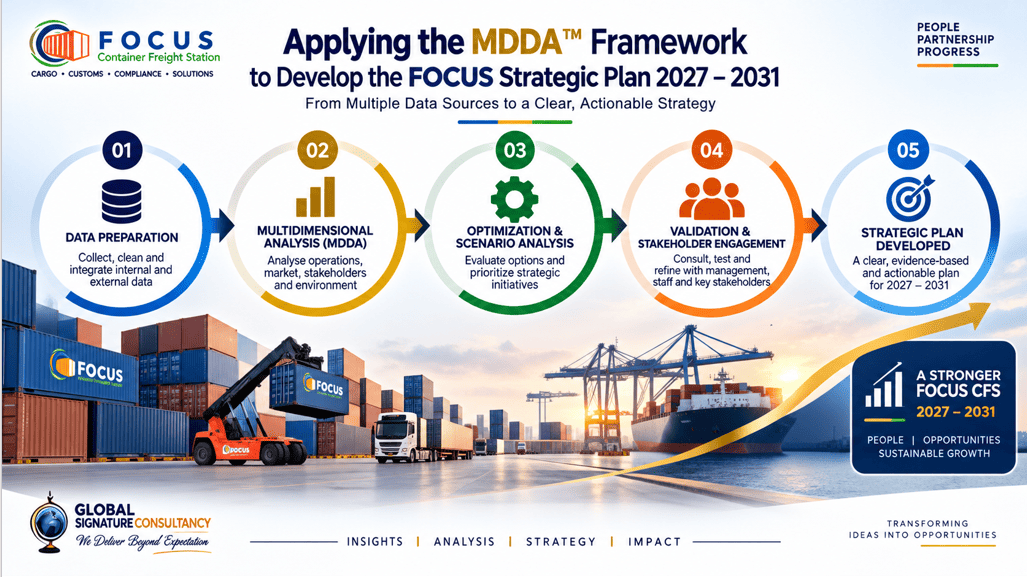
For the FOCUS CFS strategic planning engagement, these principles were adapted into a practical five-stage strategic-planning sequence:
DATA PREPARATION → MULTIDIMENSIONAL ANALYSIS → OPTIMIZATION & SCENARIO ANALYSIS → VALIDATION & STAKEHOLDER ENGAGEMENT → STRATEGIC PLAN DEVELOPMENT
This adaptation is important. It demonstrates that MDDA is not intended to impose one rigid analytical procedure on every assignment. Its underlying principles can be translated into a process appropriate to the decision problem and organizational context.
Stage 1: Data Preparation
The first stage focused on preparing the evidence required for strategic analysis.
This involves identifying, collecting, cleaning and integrating relevant internal and external information.
For a strategic planning process, relevant evidence may include:
- organizational performance information;
- operational records;
- financial information;
- customer and market information;
- stakeholder perspectives;
- human-resource information;
- previous strategic-plan performance;
- sector and industry information;
- competitive information;
- regulatory developments; and
- economic, technological and environmental trends.
The purpose is not simply to accumulate data. The objective is to establish an evidence base that is relevant to the strategic questions facing the organization.
Stage 2: Multidimensional Analysis
Once the evidence has been prepared, MDDA encourages analysis across multiple dimensions rather than examining each source independently.
Within the FOCUS strategic-planning process, this stage was designed to analyse dimensions such as:
- operations;
- market conditions;
- stakeholder perspectives;
- organizational performance; and
- the wider operating environment.
The objective is to identify relationships, patterns, constraints, opportunities and strategic issues that may not be apparent when individual datasets or reports are considered separately.
This multidimensional perspective can strengthen familiar strategic-planning tools by providing a more integrated evidence base for interpreting organizational strengths, weaknesses, opportunities, threats and emerging strategic questions.
Moving Beyond Isolated Strategic Planning Evidence
Consider a hypothetical strategic issue involving declining operational efficiency.
Operational data alone may show that processing times are increasing.
However, a multidimensional analysis may also examine staffing, equipment utilization, customer demand, technology, process design, financial constraints and external conditions.
The strategic issue may therefore be understood differently once the dimensions are considered together.
This is one of the central ideas behind applying MDDA to strategy: strategic evidence should be structured around the decision problem rather than around the boundaries of individual datasets or departments.
Stage 3: Optimization and Scenario Analysis
Strategic planning involves choices.
Organizations normally face more possible initiatives than they can implement simultaneously. Financial resources, management capacity, time, technology, people and operational constraints require priorities to be established.
The optimization and scenario-analysis stage therefore focuses on evaluating strategic alternatives and considering their implications.
This may involve questions such as:
- Which strategic initiatives should receive priority?
- Which combinations of initiatives are realistic within available resources?
- What dependencies exist between strategic interventions?
- What risks could affect implementation?
- How could different market or operational scenarios affect strategic choices?
- Which initiatives could provide the strongest contribution to strategic objectives?
Optimization in this organizational context should not be understood only as mathematical model optimization. It also involves systematically evaluating alternatives against strategic objectives, evidence and practical constraints.
The Role of Scenario Analysis
Strategic plans operate in environments that can change significantly during their implementation period.
Market conditions, technology, customer expectations, regulation, economic conditions and competitive dynamics may change between 2027 and 2031.
Scenario analysis can therefore help management consider how different future conditions could affect strategic assumptions and priorities.
Rather than attempting to predict one future with certainty, scenarios help organizations consider alternative possibilities and identify strategies that remain sufficiently robust under changing conditions.
Stage 4: Validation and Stakeholder Engagement
Analysis alone should not determine organizational strategy.
MDDA places significant emphasis on validation because analytical findings must be interpreted within their operational and institutional context.
Within strategic planning, stakeholder engagement provides an important form of validation.
Management, staff and other relevant stakeholders can help:
- verify whether analytical findings reflect operational reality;
- identify contextual factors that may not appear in formal datasets;
- challenge assumptions;
- assess whether proposed strategic priorities are realistic;
- identify implementation constraints;
- refine strategic objectives and initiatives; and
- strengthen organizational ownership of the resulting strategy.
For the FOCUS process, consultation, testing and refinement with management, staff and key stakeholders formed part of translating analysis into strategic direction.
Why Stakeholder Validation Matters in a Data-Driven Approach
Data-driven decision-making should not be confused with data-only decision-making.
Quantitative evidence can reveal important patterns, but organizations also contain institutional knowledge, professional experience and contextual information that may not be captured fully in structured datasets.
Combining analytical evidence with stakeholder validation therefore provides a stronger foundation for strategic decisions than relying exclusively on either data or consultation.
Stage 5: Strategic Plan Development
The final stage translates the validated evidence and strategic choices into an actionable strategic plan.
For FOCUS CFS, the intended result is a clear, evidence-based and actionable Strategic Plan for 2027–2031.
The strategic plan provides the structure through which strategic direction can be translated into objectives, initiatives, performance measures, responsibilities and implementation priorities.
The MDDA-informed process therefore connects:
EVIDENCE → ANALYSIS → STRATEGIC OPTIONS → VALIDATION → PRIORITIES → IMPLEMENTATION FRAMEWORK
This is important because the value of strategic analysis ultimately depends on whether it can be translated into implementable organizational action.
Connecting MDDA with Evidence-Based Strategic Planning
The FOCUS application also demonstrates the relationship between MDDA and the wider discipline of evidence-based decision-making.
Data analytics can help organizations identify patterns, investigate performance, evaluate alternatives and monitor results. MDDA extends this logic by emphasizing multidimensional evidence integration, optimization, validation and the connection between analytical findings and organizational action.
Explore How Data Analytics Can Improve Evidence-Based Decision-Making →
Within strategic planning, these principles can help create a stronger connection between organizational evidence and strategic choices.
How MDDA Complements Established Strategic Planning Tools
Applying MDDA does not require organizations to abandon established strategic-planning tools.
Techniques such as SWOT analysis, PESTEL analysis, stakeholder analysis, institutional assessment, performance review and scenario planning can remain valuable.
MDDA can provide an analytical layer that helps connect the evidence feeding those tools.
For example:
- operational and performance data can strengthen institutional assessment;
- external datasets can strengthen environmental analysis;
- stakeholder evidence can strengthen needs and expectations analysis;
- trend analysis can strengthen strategic forecasting;
- scenario analysis can strengthen evaluation of strategic alternatives; and
- performance analytics can strengthen subsequent strategy monitoring.
The objective is therefore integration rather than replacement.
From Strategic Plan Development to Strategic Learning
The development of the strategic plan is not the end of the MDDA logic.
Once implementation begins, monitoring information can create a new stream of evidence about progress, performance and changing organizational conditions.
This creates a continuing cycle:
STRATEGY → IMPLEMENTATION → PERFORMANCE DATA → ANALYSIS → LEARNING → STRATEGIC ADAPTATION
Over the 2027–2031 implementation period, appropriate monitoring and evaluation can therefore provide evidence for management review and future strategic adjustments.
Importantly, future evidence will also be necessary before conclusions can be drawn about the outcomes associated with the strategy or the effectiveness of the MDDA-informed planning approach.
What This FOCUS Application Demonstrates
The FOCUS CFS engagement provides an applied example of translating MDDA from its original research foundation into a consulting context.
At this stage, the case demonstrates that MDDA principles can be adapted and operationalized within a strategic-planning process through:
- structured preparation of multiple sources of evidence;
- multidimensional strategic analysis;
- evaluation of strategic alternatives;
- scenario analysis;
- stakeholder validation;
- translation of evidence into strategic priorities; and
- connection of strategy with future monitoring and learning.
It should not yet be interpreted as evidence that MDDA has caused particular organizational performance outcomes at FOCUS CFS. Those questions require implementation experience and subsequent evaluation.
From Research to Applied Consulting
The development of MDDA can be understood as a continuing progression:
DOCTORAL RESEARCH → MDDA METHODOLOGY → ORGANIZATIONAL APPLICATION → IMPLEMENTATION EVIDENCE → LEARNING → REFINEMENT
The FOCUS strategic-planning engagement represents an important organizational application within that progression.
It demonstrates how research-derived methodological principles can be translated into a practical consulting process while retaining the importance of evidence, validation and professional judgment.
Implications for Other Organizations
Organizations considering a more evidence-driven approach to strategic planning can draw several practical lessons from this application.
First, strategic planning should begin with clearly defined organizational questions rather than immediately moving to strategy workshops or templates.
Second, relevant evidence may exist across multiple organizational and external sources and should be considered together where appropriate.
Third, analytical findings should inform strategic choices but should be tested against institutional knowledge and stakeholder perspectives.
Fourth, scenario analysis can help organizations consider uncertainty rather than assuming that current conditions will remain unchanged throughout the strategy period.
Finally, strategic planning should connect directly with implementation, monitoring and organizational learning.
Conclusion
The FOCUS Container Freight Station Strategic Plan 2027–2031 provides a practical case of applying the principles of the Multidimensional Data-Driven Approach to organizational strategic planning.
The approach moves from data preparation through multidimensional analysis, optimization and scenario analysis, and stakeholder validation toward the development of an evidence-based strategic plan.
The case also illustrates an important stage in the continuing development of MDDA: moving from a methodology established in a specific doctoral research context toward carefully documented organizational applications.
As implementation progresses, monitoring and evaluation will provide further evidence about the strategic plan and create opportunities for organizational learning. Until that evidence exists, the significance of this case lies in demonstrating how MDDA can be adapted as a structured, multidimensional and evidence-driven approach to the strategic-planning process.
Related Projects
Related Insights
Related Expertise
Explore GSC services connected to this Insight and complementary expertise that can support wider institutional outcomes.

Strategic Planning
Strategic planning consultancy for public institutions, private companies, universities, NGOs and development organizations, covering strategic plan development, review, implementation frameworks, performance indicators and institutional roadmaps.
Explore Service →
Research & Surveys
Research and survey evidence can strengthen situational analysis, stakeholder assessment and evidence-based strategic decision-making.
Explore Service →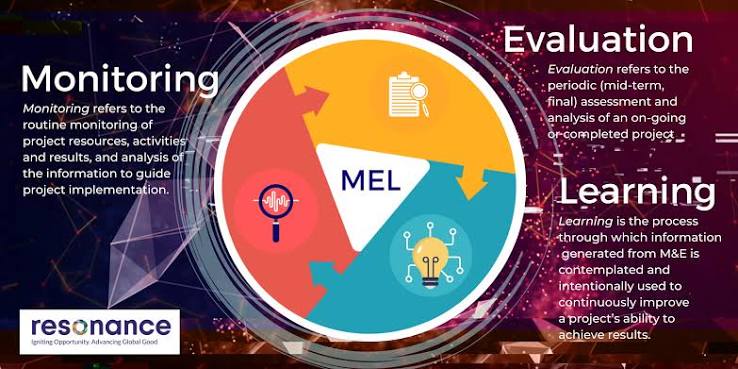
Monitoring, Evaluation & Learning (MEL)
M&E and MEL frameworks help translate strategic objectives into measurable indicators, results, performance monitoring and institutional learning.
Explore Service →
Policy Development & Institutional Frameworks
Policy and institutional framework development can support the governance, procedures and institutional arrangements required to implement strategic priorities.
Explore Service →
Business Planning & Organizational Development
Business planning and organizational development can support growth initiatives, institutional strengthening and organizational changes arising from strategic priorities.
Explore Service →
Capacity Building and Training
Capacity building helps leadership and staff develop the knowledge, skills and institutional capabilities required to implement strategy effectively.
Explore Service →